Student Projects
Student/Faculty Essays on 2026 Gallery Exhibition
Infinite Variety: Selections from the UM-Dearborn Glass Collection
Glass and Art
When we think about art, we often think of paintings or marble sculptures, but for thousands of years, glass has always been in the minds of artists and craftsmen. By the 20th century, glass had become a medium for artists to express their ideas and emotions. Artists across the world were drawn into the medium from different backgrounds, and they learned how to blow or work glass themselves or to design it, working with companies such as Daum or Baccarat to create glass sculptures. These works are all unique, and all create art out of a material often considered to be only functional. The works in this section create a conversation that is larger than art glass, focusing on tales and mythology that are culturally significant; on other art movements, like Surrealism, that arose as responses to cultural moments such as the World Wars; and on social habits in everyday lives.
There is no one path to becoming a glass artist or a singular technique to work within the glass medium. Oftentimes, artists who had specialized in a different medium came to discover glass; many were ceramicists, others were painters, and some were designers for other materials. Painters including Salvador Dalí and Maurice Legendre collaborated with Daum, an art glass company, to create sculptures in Daum’s perfected version of an ancient technique, pâte de verre (Daum’s technique is called pâte de cristal). This technique uses a glass paste for which sculptors create molds for casting, which also allows for multiple copies to be made from one design (Daum 1978). Salvador Dalí’s art glass sculptures continue his long-held conversation with the Surrealist movement alongside his works in other media. Maurice Legendre's collaboration with Daum titled Promethee (1975) depicts the muscular torso of Prometheus (Lilac Gallery, Maurice Legendre), in contrast to Legendre’s most recognizable paintings of cityscapes. The spirit of collaboration and different artistic approaches in the glass world does not end with singular artists and a company making a sculpture. Companies would collaborate and create magnificent pieces of art such as Resita, the Mountain Goat Head (1972).
Kyohei Fujita incorporated his Japanese heritage into a what was, at the start of his career, a new artistic medium, glass. Featured in this section are two pieces from his Kazaribako series. The series itself takes a significant part of Japanese culture, silk and lacquer boxes, and adds a twist in glass with its multilayered translucency. Fujita became a great success in Japan with his art glass after starting out at his cousin’s glass manufacturing studio, eventually gaining fame in the United States (Takeda 2000, 26-34).
The American Studio Glass Movement was initiated by Harvey Littleton and other artists turned glassblowers, who pushed the boundaries of glass and what it means as an art form at a time where glass was viewed only as functional in America (O’Connor 2025, 73-83) This led the way for younger American artists to choose glass as their primary medium for social commentary and experimentation. Matt Eskuche has used his works to comment on and critique modern consumer culture by replicating crushed and discarded bottles and cups with skill, care, and wit. His paradoxical glass “trash” is just one example of contemporary artists expressing their personal visions through the art of glass. (Eskuche, About).
This section highlights the creativity of collaboration and open-ended possibilities of the art glass community. Artists around the world are able to explore themselves, their heritage, and the society around them through art glass.
Works Cited
Eskuche, Matt. n.d. “About.” Accessed November 6, 2025. https://www.matteskuche.com/about.
Lilac Gallery, n.d. “Maurice Legendre.” Accessed November 1, 2025.
https://www.lilacgallerynyc.com/maurice-legendre.
O’Connor, Erin. 2025. “Hotshop: Placing the Genesis of American Studio Glassblowing.”
Canadian Review of American Studies 55(1): 68–100.
https://doi.org/10.3138/cras-2025-005.
Lynggaard, Finn. 2000. Kyohei Fujita The Man and His Work. Borgens Forlag.
Pâte de Verre. 1978. Nancy, France: Daum. Accessed November 1, 2025.
https://drive.google.com/drive/u/1/folders/1CQx82js6Ro2rd7OcBx5lQfT7BTukkYW4.
Daum. n.d. “Know How. Our Steps.” Accessed December 13, 2025.
https://daum.fr/en-us/pages/our-know-how-daum.
Glass and the Prism
The art of glass has always been embedded in technology and society. The discovery of glass as a medium more than 5000 years ago put artisans into workshops that, in ancient Egypt, were controlled by the royal palace. The products from these ancient royal workshops encompassed a wide array of techniques from casting to core-forming and the addition of mineral oxides to produce a range of brilliant colors (Whitehouse 2012, 17-18). Glass was, from its origins until the Roman innovation of glassblowing, an elite material with prices out of reach for the ordinary person. The democratization of glass was inextricable from technological advancement, as blowing allowed glassware to become practical, widely commercial, and accessible to middle-class households (Whitehouse 2012, 31-32).
Glass art and technology has evolved hand in hand since that time. One major technological advancement was the invention of optical glass in the early 19th century after decades of nationalist, industrial, and commercial competition and rivalries across Europe (Grossman 2024). Optical glass, with its blemish-free clarity, was sought for use in lenses for astronomical and maritime telescopes, binoculars, and microscopes–the very instruments of scientific discovery. By the mid-20th century, then-Czechoslovakia, now Czech Republic, had become a major producer of optical glass. Glassmaking, practiced in Bohemia (now Czech Republic) since the 11th century, evolved and adapted over centuries into distinctive local production traditions. These include that of exceptional colorless glass that was coldworked with techniques derived from gem carving and cutting such as in the “Bohemian crystal” goblets widely exported in the 17th and 18th centuries; that of cast glass for both architectural decoration and sculpture as well as for mirrors; and that of laboratory and optical glass that developed in the early 19th century (Ĉadík 1938, 6; Ĉtyorký 1938, 22). This remarkable Bohemian tradition encompasses several abstract sculptures featured in this exhibition.
The relationship between glass and political control also extended into this region well into the 20th century. Under the communist regime in then-Czechoslovakia, freedom of speech was repressed in society, extending to artistic expression. Traditional media of “fine art” such as painting and sculpture experienced state supervision to encourage the adoption of the Soviet Socialist Realist style and the censorship of so-called, “decadent” and “Western” styles, such as abstraction. Yet glass, a medium that had been considered a craft due to the practical uses of its products, escaped the strictest controls (Oldknow 2003, 42-44). What then emerged from the communist regime’s perceptual bias prioritizing “fine” arts over “minor” arts was a transformation of Czech art glass, featuring coldworking and casting that had long been part of the regional tradition, but also a focus on abstraction in form, use of color, and exploration of light (Jackson 2008, 45). The technological innovation of optical glass became a core element of the artistic innovation of Czech art glass, necessitated by politics but at the same time organically stemming from the Czech glassmaking heritage. The lasting reputation of the Czech glass industry in the 20th century facilitated the export of glass products to the West and allowed for the work of Czech glass artists including Frantisek Visner, whose work is included in this exhibition, to show their work at the 1967 Montreal Expo, one year before the brutal Soviet invasion of Czechoslovakia. The Montreal Expo brought the unique–but little-known, due to its isolation behind the Iron Curtain– Czech art glass school to international attention and acclaim in a moment before everything changed for the artists (Oldknow 2003, 46-47). Thus, while the Czech art glass sculptures in the Prism section may seem cold and austere, they in fact represent the Promethean fire of human progress and freedom.
Works Cited
Ĉadík, Jindŕich. 1938. “Modern Glassmaking in Czechoslovakia.” In Modern Glassmaking in
Lilac Gallery, n.d. “Maurice Legendre.” Accessed November 1, 2025.
Czechoslovakia. Milka Hipmanová.
Ĉtyorký, Ing. V. 1938. “The Czechoslovak Glass Industry.” In Modern Glassmaking in
Czechoslovakia. Milka Hipmanová.
Daum. n.d. “Know How. Our Steps.” Accessed December 13, 2025.
Guinand, and the Development of Optical Glass.” Ambix 71(4): 432-456. doi:
10.1080/00026980.2024.2419312
Jackson, Lesley. 2008. "Bloc Party." Crafts (213): 44-51.
Oldknow, Tina. 2003. “Behind the Iron Curtain: Czech Glass of the 1950s and 1960s.” Glass
Quarterly 90: 42-47.
Whitehouse, David. 2012. Glass. A Short History. British Museum Press.
Light and Glass
Throughout history, the question, “what is light?” has been debated, answered, and continuously explained through science. At the same time, artists began their own exploration of light and its relation to the world. Artists have observed how light provides dimension, depth, and mood, and conveyed these qualities in their artworks. This exploration and understanding of light have prevailed and evolved through different art forms. While light has been observed most obviously within the traditional arts such as painting, it is of utmost importance and essentially best represented through art glass. From the way glass shines and illuminates, to the way it reflects and obscures light, one could argue that glass is the best medium to study light as an art medium in itself.
A vessel that can be found in glass from ancient to modern times is the vase. A vase’s physical opening allows light to enter, then the walls of the vessel change the light as the opaque compounds of glass partially absorb the light waves while the translucent elements allow the remaining light waves to glow softly through the body. Artist Bill Warhutt’s red vase is a perfect example of this transformative process as it emanates a red-orange glow in the center of the vessel, the thinnest and semi-translucent portion of the vase (Stamelos Gallery Center, n.d.). Helen Aitken-Kuhnen’s Blue Iris Bowl (Mauve) in the Prism section of this exhibition shares this luminosity with red vase as its concavity allows light to illuminate the semi-translucent sculpture from within (Cotton, n.d.).
Another approach to glass and light is the use of opacity in its most impenetrable form. In Prisoner of Continuity by Scott Chaseling the glass vase does not emit any sort of glow, but instead absorbs the range of the color spectrum. Chaseling combines the many qualities of glass to create contemporary designs with the use of opaque colors and patterns (Corning Museum of Glass, n.d.), and builds “depth and intensity, each stratum amplifying the vibrancy and interplay of light” and the colors that are being represented (Gutierrez 2025). Prisoner of Continuity utilizes color and designs on both the interior and exterior to evoke certain emotions and express different ideas or narratives.
In addition to opacity, color, and shape, there are other methods of obscuring and creating different lighting effects. Surface treatments of glass artworks, like Untitled by Colin Reid, create a different dynamic between light and glass. Colin Reid’s sculpture plays with forms that are found in nature, imitating volcanic rock. The opaque colors as well as the frosted texture of the glass elicit different reactions. The obscuration of the interior of the glass allows for a focus on the form and colors working together in allusion to obsidian and lava from volcanos. The frosted surface of the glass, however, still allows the light to penetrate, creating a sense of tension similar to how one might feel as a volcano erupts with glowing lava from its solid and dark cone, not knowing if it will continue or if the disaster has ceased.
As you walk through the exhibition, please take notice of how some artists focus on color, while others emphasize radiance and luminosity. The glass medium’s potential to be opaque, frosted, translucent, or transparent works hand in hand with light, creating works that evoke emotion. Think about how the light and glass make you feel in the moment. By observing how glass artworks interact with light, you will be able to understand both mediums.<>
Works Cited
Corning Museum of Glass n.d. “Scott Chaseling: Biography.”
https://people.cmog.org/bio/scott-chaseling.
Cotton, Laura, n.d. “Complete Catalog Record: Blue Iris Bowl (Mauve).” Stamleos Gallery Center.
https://stamelos.pastperfectonline.com/webobject/D0E41556-AE74-4EB5-B2E7-625188169501.
Gutierrez, Tuesday. 2025. “Scott Chaseling: Breaking the glass ceiling.” Momardi Art Collective, August 16.
https://momardi.com/blog/scott-chaseling/#:~:text=In%20my%20glass%20work%2C%20color,vibrancy%20and%20interplay%20of%20light.
Stamelos Gallery Center, n.d. “Complete Catalog Record: Red Vase.”
https://stamelos.pastperfectonline.com/webobject/A8C95F9C-6C32-404B-B078-746257542185.
Glass, Ancient and Modern
To tell the story of studio glass, it is helpful to understand the ancient origins of glasswork. Many modern vessels reflect ancient ones through their design and method of production. Glasswork was first produced by the core-forming method in the 16th century BCE, with blown glass developing in the 1st century BCE, the latter of which is still commonly produced worldwide.
Charles Lotton’s “Red Vase” exemplifies the connection between the ancient and the modern. The shape of Lotton’s “Red Vase,” as well as many of his other works, is similar to ancient core-formed vessels, like the aryballos flasks from Greece, with a round body, discreet rim, and few ornamental glass additions. The designs on the vase, termed “festoons,” were commonly used by ancient Egyptian glassmakers and are created by trailing glass over the surface of the vessel, tooling it to create the pointed design, and marvering it smooth (Tait 1991, 26-46).
Additionally, the opacity and form of “Red Vase” reflects the appearance of early glass vessels at a time when clarity of glass was not always desired or achievable. In ancient times, glass was not extremely expensive or prestigious and was used to mimic the appearance of more expensive materials. Ancient Egyptian festoon-decorated vessels were often made of opaque colorful glass meant to mimic faience, lapis lazuli, or other precious stones, colors found on ceramics and furniture inlays (Tait 1991, 26-33). The opacity and smooth contours of “Red Vase” evoke ancient works meant to mimic ceramics and showcase the owner’s wealth and prestige. Colorless glass, when sought, was not always possible to create. Many ancient glass pieces were tinted greenish-blue due to the natural presence of iron oxides in the sand that was melted to make the glass and which was hard to counteract. However, modern colorless glass can be achieved by adding various different chemical compounds (Whitehouse 2012, 10). The signature clarity and rainbow refractions of crystal glass is benefitted by being colorless, examples of which are the crystal apothecary jars from Lauscha, Germany.
Kim Harty’s mosaic pieces mix modern developments in glass with ancient techniques, achieving colorless translucency while employing the mosaic method, which was used by Hellenistic Greeks and ancient Romans (Whitehouse 2012, 27-28). Harty creates mosaic vessels that appear to be made of many cells, mimicking a sample of an organism viewed under a microscope. The edges of her pieces are not even, as they are for many ancient pieces, but staggered, following the pattern the cells make when joined together. She first creates glass canes, composed of clear glass with a colorful core in her chosen design. When she fuses together cuttings from these canes they appear to form cells within an extracellular matrix, the clear space between cells.
In the Christian period, mosaic vessels fell out of fashion with the development of blown glass, followed by the development of flameworking in the 15th century (Lierke 1990, 368). Glass pieces made in Lauscha reflect the ancient method of flameworking in style and form but were created at a size many times smaller than ancient pieces. Flameworking allows the glassworker to handle the glass at close range, resulting in more variability and detail than glassblowing permits. They are similar in appearance to ancient vessels, with thin pulled glass handles, decorative trailed glass designs, and a similar contour of the neck and body. The size of these pieces shows a modern take on an old style and demonstrates how improvements in technology lead to an improved ability to capture detail in glass. Additionally, the flameworking method was more accessible as the tools necessary are cheaper and smaller and, overall, less equipment is needed. In Lauscha, flameworked glass was not limited to a workshop, but rather expanded into a cottage industry, allowing many people to learn flameworking. Lauscha is renowned for their glass flameworked Christmas tree ornaments, which are similar in appearance to blown glass pieces, but with greater detail.
The use of ancient techniques and designs in modern studio glass results in new and interesting mixes of new and old elements, from mosaic pieces inspired by science to miniature mimics.
Works Cited
Lierke, Rosemarie. 1990. "Early History of Lampworking-Some Facts, Findings and Theories."
Part 1: Kunckel's description of lampworking in the Arts Vitraria Experimentalis."
Glastechnische Berichte, 63(12): 363-369
Tait, Hugh, ed. 1991. Glass. 5000 Years. Harry N. Abrams, Inc.
Whitehouse, David. 2012. Glass. A Short History. British Museum Press.
Glass and Nature
Glass is made of sand, an obvious statement but one that enforces the natural allure of glass art. The sand that lives in our bags after the beach is the same sand that allows us to create both a practical cup and a stunning oceanic form. Glass’s malleable nature makes it the perfect medium for conveying the natural world. The twisting shapes of trees and the bends of a crackling brook have intrigued our minds and inspired our art for centuries. The works in this section are no different.
Take for example, Negreanu’s Untitled piece, in which the artist plays with the ever-flowing nature of glass akin to the flow of a soft river stream. Utilizing sand in yet another way, he sandblasts each piece to engrain it with a foggy, almost sea-glass-like feel. Negreanu utilizes freeform shaping and slumping of glass to invoke feelings of the awe-inspiring power of water. He further engages with the idea of flowing forms by twisting the glass to create wave-like patterns. In this way, artists play with the glass to mimic the very thing it comes from, sand.
However, glass art is not limited to depictions of flowing water; it also evokes more physical elements of nature. More Abundant Chaos, created by Toots Zynsky, features an example of the flora in nature. Focusing on the plantlike greens and vibrant reds, More Abundant Chaos works with the familiar features of a flower, redesigned for the contemporary glass movement. Zynksy abstracts plant matter to create an intriguing form that honors the nature of the flower. Zynsky fuses and slumps her glass to create the upturned shape of this piece. The center of this piece is meant to remind viewers of a blooming flower, a reminder of springtime's joy.
Other pieces in this section confront the vast landscapes and the realms of the inner self. The many vessels in this section are considerations of the geological formations of the natural world and seem to draw us away from the clear oceanic views into the swirls of wind. These artworks inspire us to look at the humble rock as represented in the geode-like patterns on Vessel created by Richard Ritter. Viewers are called to identify the stone-like exterior of the piece and turn these reflections inward.
Perhaps you are drawn to the more abstract nature of glass, the slumping and warping of colors creating dynamic movement that remind us of the spontaneity of the breeze blowing through grass. Untitled, from the Macchia Series by Dave Chihuly is one of the pieces the artist created after he was inspired to utilize all of the colors in his workshop. The piece gains its name from the Dale Chihuly’s signature colored spots called macchia, which is Italian for spot. He refers to the white, interior layer of these creations as the “clouds,” which he then speckles with color, demonstrating Chihuly’s spontaneous artistic vision. Chihuly describes his pieces as being centered around “fire, molten glass, human breath.”1 Dale Chihuly simultaneously examines the natural forces of fire and how they impact not just the glass, but also human nature. The natural forms of glass not only honors the natural world, but also the progress of the glass art movement that returned the practical medium of glass into natural human expression.
Works Cited
Hobbs, Robert. 1993. “Reflections on Chihuly’s Macchia.” Chihuy.com. Accessed November 8, 2025.
https://www.chihuly.com/life/writings/reflections-chihulys-macchia.
1“Homepage | Chihuly.” Www.chihuly.com, www.chihuly.com.
The Stamelos Gallery Center is located on the first floor of the Mardigian Library at the University of Michigan-Dearborn. For more information, see below for contact information. Anyone requiring accommodations under the provisions of the Americans with Disabilities Act should contact lacotton@umich.edu.
Featured University Art Collection Piece
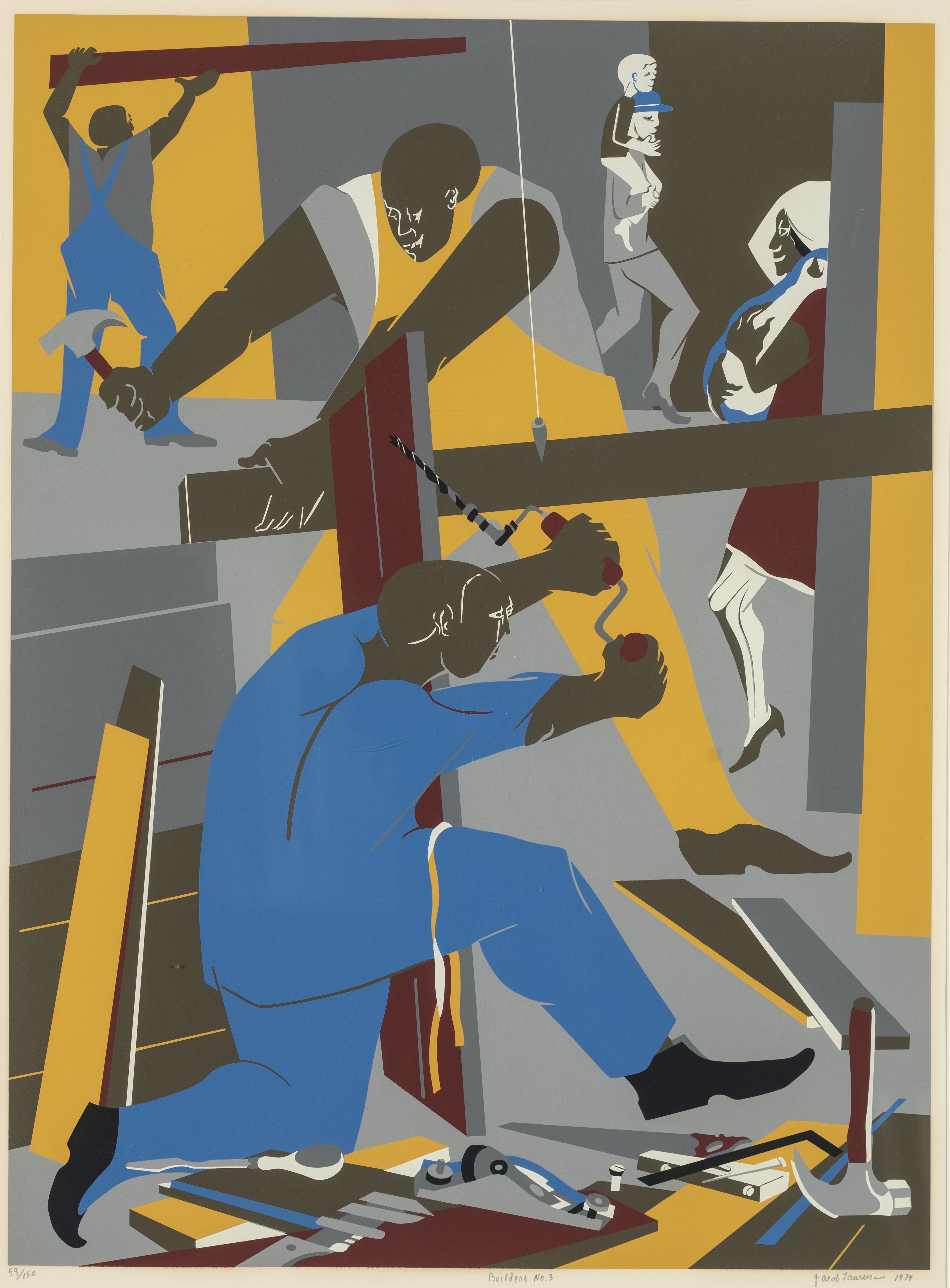
Jacob Lawrence (1917-2000), Serigraph print, 1974
Gift of Gilbert M. Frimet,
Collection of UM-Dearborn (1980.065)
Photographed by Tim Thayer
This powerful serigraph print from the permanent collection was created by Jacob Lawrence (1917-2000), one of this century's most widely acclaimed artists.
Lawrence was born in Atlantic City, New Jersey, but moved to Harlem, New York, at 13. He is among the few painters of his generation who grew up in a Black community, received instruction primarily from Black artists, and was influenced by the experiences of Black individuals.
Lawrence's artwork portrays the lives and struggles of the Black community, capturing their experiences through several series focused on figures such as Toussaint L'Ouverture, Frederick Douglass, and Harriet Tubman, as well as themes related to life in Harlem and the civil rights movement of the 1960s. His style is characterized by vibrant colors and abstract forms.
In the 1940s, during a time of widespread segregation, Lawrence broke racial barriers by becoming the first Black artist whose work was acquired by the Museum of Modern Art in New York City.
He stated, "If at times my productions do not express the conventionally beautiful, there is always an effort to express the universal beauty of man's continuous struggle to lift his social position and to add dimension to his spiritual being."
Researched and written by:
Julianna Collins, Stamelos Gallery Center former intern, UM-Dearborn art history/museum studies graduate, Class of 2025
Contact Us
- Stamelos Gallery Center
- 1st Floor, Mardigian Library, UM-Dearborn
- 4901 Evergreen Road, Dearborn, MI 48128
- Directions
- Laura Cotton
- Art Curator and Gallery Manager
- 313-593-5087
- lacotton@umich.edu
- Autumn Muir
- Registrar and Gallery Assistant
- 313-593-3592
- aumuir@umich.edu