The New Freedom Fighters: Women And Nonviolent Resistance

Michigan Mosaic Artist Michelle Sider will present more than 40 original works she created between 2009 and 2026 for her largest solo exhibition to date.
This exhibition unfolds in three sections: Leaving Darkness, Celebrating Radiance, and Light Endures, each offering a unique perspective on light as a metaphor for memory, spiritual reflection, and resilience. As you move through the exhibition, colors shift, surfaces breathe, and textures animate scenes drawn from nature, history, and personal experience. This work is meant to be experienced slowly, attentively, and with openness.
Wednesday, May 20, 2026, 5:00pm - 7:00pm
Stamelos Gallery Center
This exhibition explores my aesthetic choices over the last 20 plus years. Not truly a retrospective because the scope is limited, the work is more of a survey; selected paintings which represent the various bodies of work undertaken over more than two decades.
Our experiences help us construct meaning, respond to others and define our cultural frame of reference. Similarly, the artist impacts their audience through the construction of images based on their connections, sensibilities and experiences. This is what I term as an aesthetic frame of reference, hence the title of this exhibition.
The works from 2020 through 2026 are heavily influenced by my childhood; exposure to the aesthetic choices made by a father who was an eccentric and complicated person, unable to fully be himself and thus, chose to transform our living spaces to communicate his vision of the world.
The paintings from 2003 to 2014 explore abstraction of the landscape; translating the physical attributes of land (and sky) as if I were zooming in on a particular surface or what a cross section of a surface might look like. As well, they highlight use of disparate materials and chemicals to create visually textured surfaces.
As the viewer, I ask you to take in my work with the understanding that while the genre of abstraction depends a great deal on spontaneity, this does not necessarily mean the act of creating is a thoughtless endeavor, where visual aesthetics are ruled by happenstance.
— Anita Bates PhD, MFA
Thursday, Sep. 03, 2026, 5:00pm - 7:00pm
Stamelos Gallery Center
Title and Dates to be determined


Thursday, Jan. 29, 2026, 5:00pm - 7:00pm
Stamelos Gallery Center
Kim Harty, Associate Professor and Section Lead of Glass,
College for Creative Studies
Sarah Kohn, Director and Curator of Collections and Exhibitions,
Flint Institute of Arts
Reception is free to the public. Complimentary beverages and hors d'oeuvres provided.
Friday, Mar. 20, 2026, 2:00pm - 3:00pm
UM-Dearborn-Mardigian Library, first floor next to Stamelos Gallery
Event is free to the public and light refreshments provided.
In the early 1960’s, Harvey Littleton set out to make glass blowing a creative experience for craftspeople and artists in a small studio environment. This was the beginning of the American Studio Glass Movement that transformed glass from a factory-made product into an independent art form created in private studios. Glass is a medium of transitions.Most American participants were working in another medium before coming to work in glass as a primary material, many times, adding it to the repertory of their total art expression. As the movement grew, reaching out for international influence also assisted the artists’ endeavors... View MoreThe Stamelos Gallery Center is located on the first floor of the Mardigian Library at the University of Michigan-Dearborn. For more information, see below for contact information. Anyone requiring accommodations under the provisions of the Americans with Disabilities Act should contact (313)593-5087.

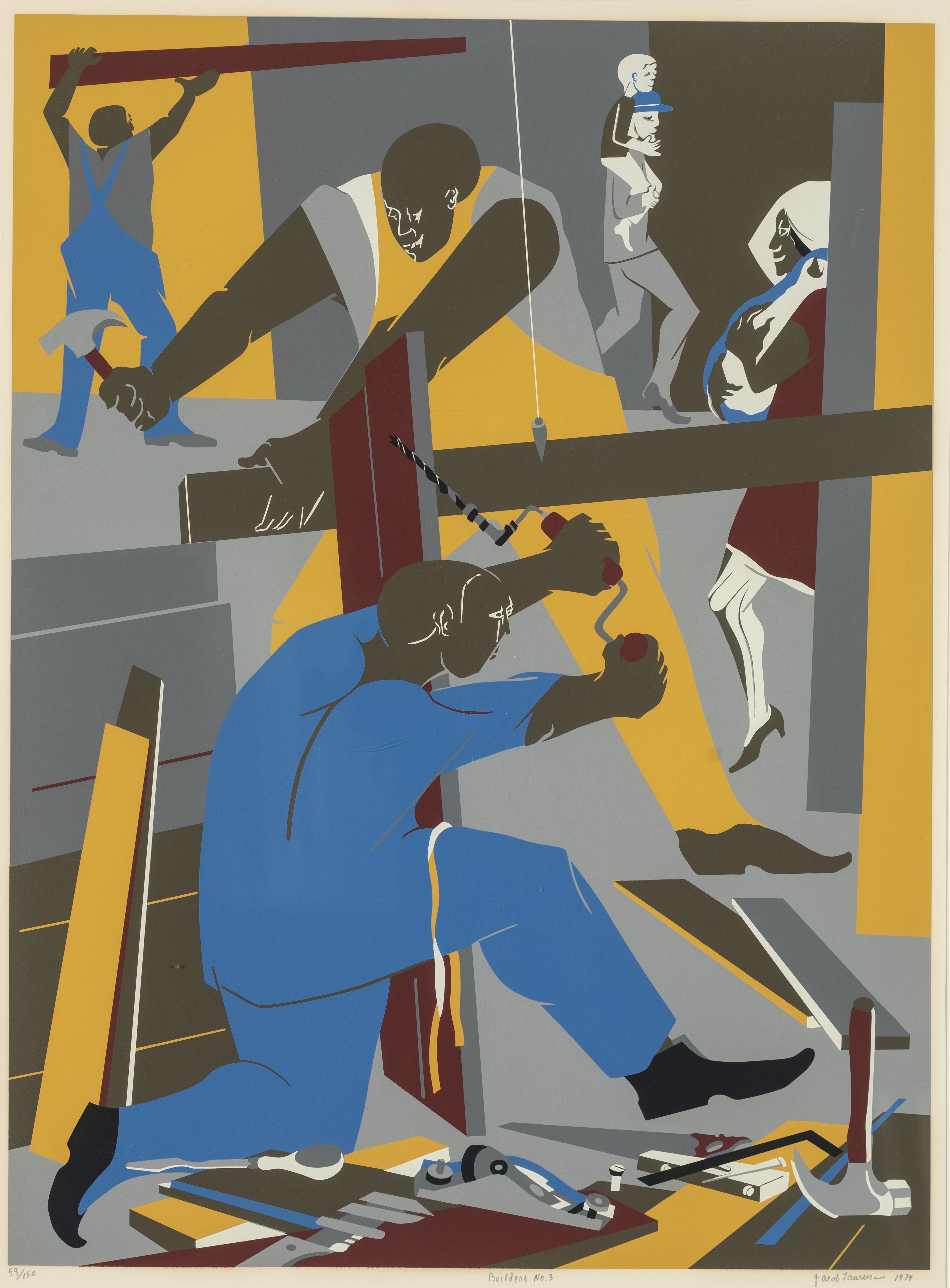
Jacob Lawrence (1917-2000), Serigraph print, 1974
Gift of Gilbert M. Frimet,
Collection of UM-Dearborn (1980.065)
Photographed by Tim Thayer
This powerful serigraph print from the permanent collection was created by Jacob Lawrence (1917-2000), one of this century's most widely acclaimed artists.
Lawrence was born in Atlantic City, New Jersey, but moved to Harlem, New York, at 13. He is among the few painters of his generation who grew up in a Black community, received instruction primarily from Black artists, and was influenced by the experiences of Black individuals.
Lawrence's artwork portrays the lives and struggles of the Black community, capturing their experiences through several series focused on figures such as Toussaint L'Ouverture, Frederick Douglass, and Harriet Tubman, as well as themes related to life in Harlem and the civil rights movement of the 1960s. His style is characterized by vibrant colors and abstract forms.
In the 1940s, during a time of widespread segregation, Lawrence broke racial barriers by becoming the first Black artist whose work was acquired by the Museum of Modern Art in New York City.
He stated, "If at times my productions do not express the conventionally beautiful, there is always an effort to express the universal beauty of man's continuous struggle to lift his social position and to add dimension to his spiritual being."
Researched and written by:
Julianna Collins, Stamelos Gallery Center former intern, UM-Dearborn art history/museum studies graduate, Class of 2025